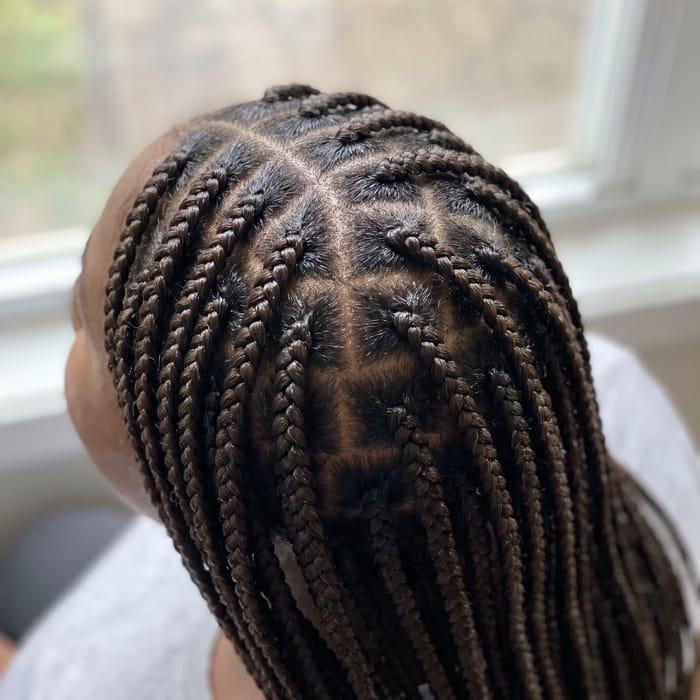
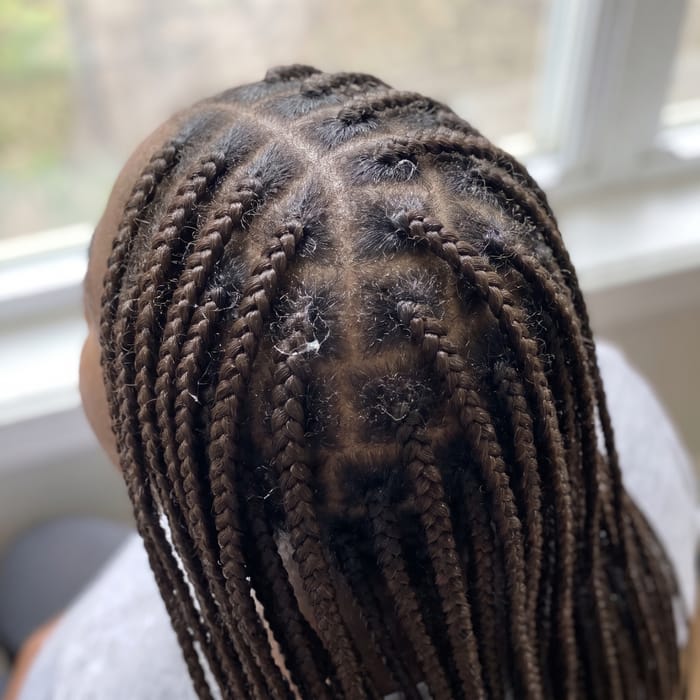
Why there’s a limit
Your hair keeps growing under the braids. Week by week the braid sits further from your scalp, and the new growth at the root carries more of its weight.
The hair you shed every day stays trapped in the braid instead of falling out, and product, sweat and dry shampoo collect at the roots. Left too long, the new growth can knot where it meets the braid, which makes takedown slower and harder on your hair.
Signs it’s takedown time
- New growth you can see at every part, not just at the front.
- Frizz at the parts that no longer lies flat after a rinse.
- Buildup or flakes at the roots that washing doesn’t shift.
- Braids that feel heavy, or have started to loosen and slide at the root.
Signs it’s too tight, whatever the week
Pulling on the roots, week after week, can cause traction alopecia: hair loss from tension. The hairline is one of the first places it shows. Dermatologists say to change the style straight away if you notice:
- pain from tightly pulled hair, or stinging on your scalp;
- crusts on your scalp;
- tenting: sections of scalp pulled up like a tent;
- broken hairs around your forehead, or a hairline that’s moving back.
Making them last, gently
- Ask for the braids around your hairline to be done looser.
- Thicker braids, and shorter ones, pull less: long braids are heavy.
- Sleep in a silk or satin scarf or bonnet: it’s gentler on hair than cotton.
- Wash the scalp, not the lengths, and let the braids dry completely (our wash day guide has the steps).
Takedown
Give it time, and work from the ends up. Expect a lot of loose hair: most people shed between 50 and 100 hairs a day, so six weeks in braids is a few thousand hairs that had nowhere to go. That’s shedding, not hair loss.
Before you wash, detangle the new growth with conditioner, using your fingers or a wide-tooth comb, ends first. Then give your hair a break before the next install: dermatologists suggest switching styles so your hair can recover from tension.